


Rise For and With the Women of Afghanistan
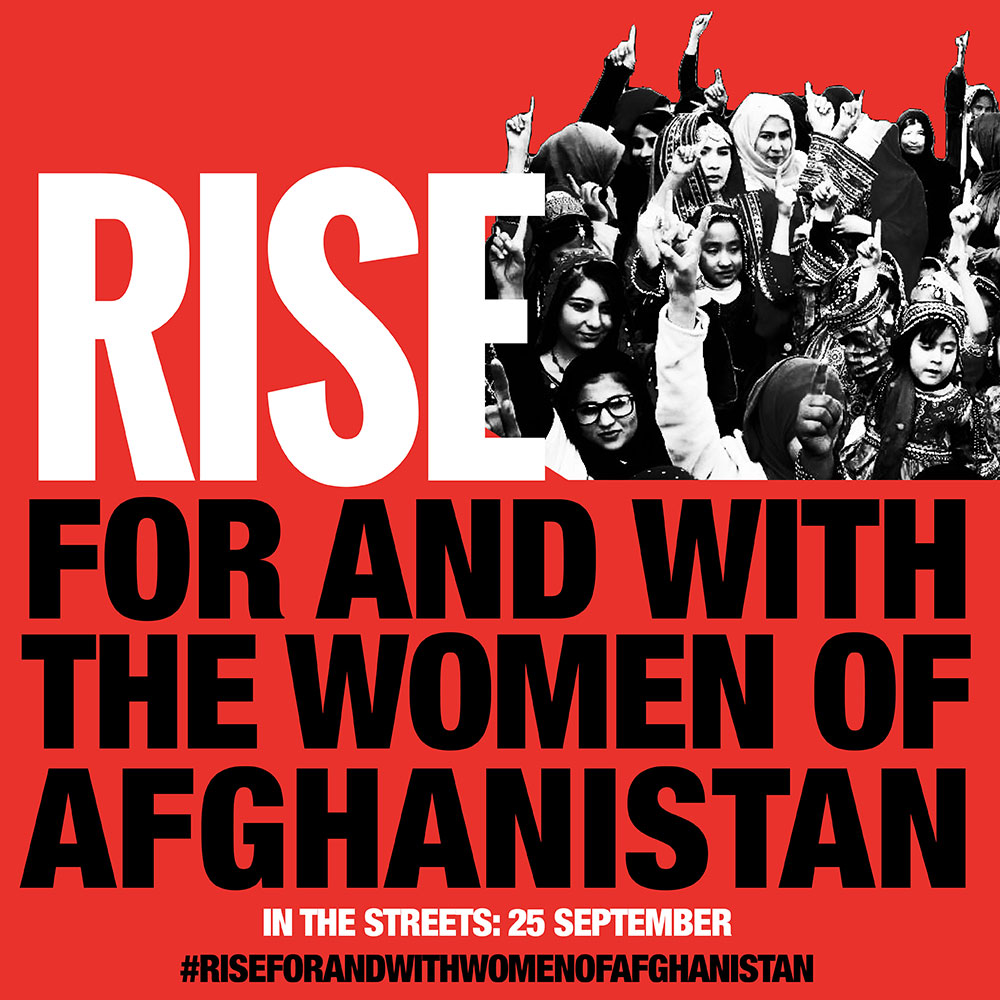
Women of the world and our allies stand with the women – and all vulnerable groups – of Afghanistan against imperialism, militarism, fundamentalism, and fascism. None of us are free until the women of Afghanistan are free.
We believe the women of Afghanistan have the right to education, to travel, to freedom of movement, to jobs, to security, just having freedom to be able to breathe and be.
We cannot underestimate the power of our solidarity at this moment.
Rage, Roar & RISE: Women of the world have our eyes on Afghanistan.
JOIN US:
In the Streets on Saturday, 25 September –
Women Of The World And All Our Allies Rise, Roar And Rage For The Women In Afghanistan.
A Global Solidarity Action In Your City, Town, School. Everywhere. RISE in the streets, stage creative political protests and artistic risings. Invite everyone, reach out to activists, students, artists, social justice groups, and more.
Activists will take to the streets in New York and Los Angeles on 25 September
Join Us
Visit onebillionrising.org/riseLA and onebillionrising.org/riseNewYork for more information & to RSVP
Access the social media toolkit»
Wear masks. Social distance. All events outside.
We follow the lead of Afghan women on the ground. We urgently call upon governments, the UN Security Council, and regional entities to:
- Refuse to recognize a Taliban government, which has no legitimacy beyond the brutal force it commands, and which terrorizes the people of Afghanistan, girls and women in particular.
- Stop all forms of support to the Taliban, including funding, providing of arms, and technical know-how.
- End imperialism, militarism, fascism and religious fundamentalism. Cut the Pentagon Budget.
- Stop and prevent manipulating women’s rights for commercial and other interests.
- Support the women’s resistance to the Taliban inside Afghanistan. Respect and support Afghan women and people’s exercise of their democratic and human rights, including their right to self-determination.
- Evacuate women and men, human rights defenders, journalists, police officers, public employees, athletes, and LGBTI+ who wish to leave the country and ensure their safe passage.
- Create an independent body of observers, made up with a majority of women, who have a track record of promoting women’s human rights to monitor the situation in Afghanistan.
- Welcome refugees, with the US and their allies assuming the responsibility of financing the cost of resettling displaced people from Afghanistan.
- Immediately open humanitarian corridors to support the people of Afghanistan.
- Stop arms trade policies and the military industrial complex, which profits from the ongoing wars in Afghanistan and elsewhere the world.
We call upon the women of the world, and our allies, to:
- Listen, share, and amplify the voices of the women of Afghanistan.
- Defend women’s rights, which are under threat in all countries, and uphold the principles of equality and secularism as the backbone of the protection of these rights.
- Expose your own government’s role in perpetuating or tolerating armed conflict and intervention in Afghanistan.
- Call for a feminist foreign policy that prioritizes sustainable peace, human security, and freedom for all.
- Understand and advocate that our common future as women is reflected in the faces of Afghan women, as right-wing populist forces that are anti-women, anti-human rights, and anti-democracy are rising around the world.
Drafted in consultation with Afghan women on the ground, One Billion Rising/V-Day, and Women’s Global Solidarity with Women of Afghanistan.
ACTION STEPS:
Access the social media toolkit here and spread the word on social media.
Use the hashtags: #RiseForAndWithWomenOfAfghanistan #StandWithWomenofAfghanistan
RISE in the streets on 25 September. Plan an action in your community. Wear masks. Social distance. All events outside. RISE in the streets, stage creative political protests and artistic risings (safely). Invite everyone, reach out to activists, students, artists, social justice groups, and more.
In New York City? JOIN US for a rally and action with Afghan activists, women’s rights leaders, Broadway stars and more will take place at Dag Hammarskjold Plaza, in sight and sound of the United Nations as the UN General Assembly meets. (Visit onebillionrising.org/risenewyork for INFO)
In Los Angeles? JOIN US as Afghan youth and activists will meet on the Sunset Strip and march to West Hollywood Park (Visit onebillionrising.org/riseLA for INFO)
SIGN up for information about 25 September events»
PLAN or FIND an event in your city/town/school»
READ about the 1 September Global Day of Online Solidarity»
READ
Worldwide Actions 9/25 Media Alert»
NYC 9/25 Media Alert»
LA 9/25 Media Alert»
SIGNEES INCLUDE (List in Formation):
Organizations

350.0rg
A Coletiva, Portugal
Abra Migrant Workers Welfare Association, HK
Activism Caucus, Association for Women in Psychology
ADEW, Egypt
Afghan Innovation Fund
African American Policy Forum
African Women’s Millenium Initiative (AWOMI) Sénégal
Alliance des Femmes pour la Démocratie, France
Alliance pour la Migration , le Leadership et le Développement (AMLD), Senegal
Alianza Nacional de Campesinas, United States
AMIHAN National Federation of Peasant Women, Philippines
All India Progressive Women’s Association (AIPWA)
Aoisora OBR, Japan
Armaan, Uganda
ArtsforWomen Indonesia
ASA (Associazione per La Sovranita’ Alimentara), Italy
Ashoka Arab World
Asia Pacific Mission For Migrants, HK
Asian Migrants Coordinating Body ( AMCB- HKCTU), HK
Asociación Akshy
Asociacion de Municipios de Mexico AMMAC, Mexico
Association de Femmes pour le Développement de Diourbel (AFDD) Sénégal
Association des albinos du Sénégal
Association des Femmes de l’Afrique de l’Ouest (AFAO), Senegal
Association des handicapés du Sénégal
Association des Juristes Sénégalaises (AJS)
Association for Promotion of Sustainable Development, India
Association mères et filles, Mali
Association of Concerned Filipinos, HK
Association of Environmental Justice in Israel (AEJI)
Association of Indonesian Migrant Workers in Hong Kong (ATKI-HK), HK
Association pour la Promotion de la Femme Sénégalaise (APROFES)
Association Rurale de Lutte contre le Sida pour le Développement Économique et Social (ARLS/DES) Sénégal
Associazione Nondasola, Italy
Associazione Tessere Culture, Italy
ATTAC Kansai, Japan
Autism Eswatini
Auburn Senior Fellows Cohort
Autism Eswatini

Back Home Org, Mexico

![BAK Realsozialismus linksjugend ['solid], Germany](https://www.onebillionrising.org/wp-content/uploads/2021/08/BAK-Realsozialismus-linksjugend-solid-Germany-logo.png)
Bangladesh Nari Progati Sangha (BNPS), Bangladesh
Banka BioLoo Limited, India
BAYAN Hong Kong and Macau, HK and Macau
Beaten but not Broken, Eswatini
BEmpower Women
Better Future, Roma Women Croatia
Boma Global, United States
Breakthrough, United States
California National Organization for Women, United States
Center for Disability Rights, United States
Center for Girls, Niš, Serbia
Center For Girls, Serbia
Center for Women’s Resources, Philippines
Center of Modern Skills, Serbia
Central Phoenix Inez Casiano chapter of the National Organization for Women, United States

CESI – Center For Education, Cancelling and Research, Zagreb, Croatia

Centro antiviolenza Roberta Lanzino, Italy
Centro di Women’s Studies “Milly Villa” – Università della Calabria, Italy
Centro Sionista de Costa Rica, Costa Rica
CESI – Center for Education, Counselling, and Research
Ci siamo rotte i tabù
The Circle of Women, United Kingdom
Club Rotarios de México AC

Colapesce, Italy
Collettivo FuoriGenere, Italy
Comité de lutte contre les violences faites aux femmes (CLVF) Sénégal
Comité des Femmes de la Fédération Sénégalaise des Associations de Personnes Handicapées (CF-FSAPH)
Community Health Empowerment Forum, Eswatini
Conseil Sénégalais des Femmes (COSEF Sénégal)
Comision Unidos VS Trata AC, Mexico
Consejo Ciudadano Ciudad de México
Consejo Ciudadano de Seguridad Morelos, Mexico
Controparola, Italy
Cordillera Alliance Hong Kong, HK
Costa Family Foundation, Italy
CRVENA, Sarajevo, Bosnia and Herzegovina

CURE, Sarajevo, Bosnia and Herzegovina
Cuyapo OFW Association Hong Kong, HK
Dancing for Birth
Decarcerate New York, United States
Department of Women’s and Gender Studies, Syracuse University, United States
Diabetes Eswatini
Diverse Voice and Action (DIVA) for Equality
Donne di classe Aprilia, Italy
Dristi Foundation, Nepal
E-Vision Japan
Emerging Leaders Forum Alumni, Fiji Islands


Equal Means Equal

ERA Coalition
Esitiz – Equality Watch Women’s Group Turkey
European Women’s Lobby (EWL)
Factory Worker’s Association, Taiwan
Faiths for Safe Water
Famigle Accoglienti
Familias Unidas por una causa AC
Farmworkers Association of Florida, United States
Fédération des Associations Féminines du Sénégal (FAFS)
Féminisme Yeah (Gauche Anticapitaliste)

Feminista, Thailand
Feminoteka, Poland
FemLink Pacific – Fiji, Tonga, Samoa, Vanuatu and Papua New Guinea
Femme, Éducation, Culture, Santé et Développement en Afrique (FECSDA) Sénégal
Femmes battues, Mali
Femmes, paix et développement, Mali
Femminismi Blog, Italy
Fiji Women’s Crisis Center, Fiji Islands
Filguys GABRIELA Association, HK
Filipino Friends, HK
Filipino Lesbian Organization, HK
Filipino Migrant Domestic Workers Union, HK
Filipino Migrant Workers’ Union (FMWU-HKCTU), HK
Filipino Migrants Association (FMA), HK
Filipino Womens Migrants Workers Association, HK
Fin de la Esclavitud AC, Mexico
Florida Rural Legal Services, Inc., United States
Fondation Heinrich Böll Sénégal
Friends of Bethune House, HK
Friends of RAWA, Japan
Fundación Camino a Casa AC
Fundacion Karla de La Cuesta AC

GABRIELA HK, HK
Gabriela Youth, Philippines
Gacehpa (groupe d’action des centres extra hospitaliers pratiquants l’avortement), Belgium

Gender and Development for Cambodia, Cambodia
GHAROA
GIE xaritu xaléyii Sénégal

Go Girl Africa, Uganda
Groupement Tacku ligey du Saloum, Sénégal
Hami DajuVai, Nepal
Haus of Khameleon, Fiji Islands
Hoja en Blanco Org, Mexico
Hollywood NOW (National Organization for Women), United States
Hong Kong Campaign For the Advancement of Human Rights in the Philippines
Horse Angels, Italy
I Profile Foundation, Uganda
IbtikiarKhana, Egypt

IFDD Togo: Initiative des Femmes pour le Développement Durable, Togo
Il Colombre, Italy
In Statu Nascendi Journal
Independent Women’s Center, Serbia
Indonesian Migrant Workers’ Union (IMWU), HK
Indonesian Migrants Muslim Alliance (GAMMI), HK
Insieme si può…ONLUS, Italy
Instituto Favela Da Paz, Brazil
International community of women living with HIV, Eswatini
International League of Peoples Struggle (ILPS HK & Macau), HK and Macau
International Migrants Alliance (IMA HK & Macau), HK and Macau
International Women’s Strike
International Women’s Alliance
IRISE(Initiative to Resist Institutional Slavery and Exploitation), Nigeria
It Takes A Village Africa Corporation, United States

JEAD Togo : Jeunes Engagés et Actifs pour le Développement, Togo
Journey of Hope for Women and Girls Eswatini
Jovenes por la libertad AC, Mexico
Justice Coalition of Religious, West India

Kaleido AC
Kirmizi Biber Dernegi, Turkey
Lady Lawyer Foundation, Italy
Lahing Kayumanggi, United Kingdom
Le Tre Ghinee, Italy
League of Indonesian Migrant Workers (LiPMI), HK
Lideres Campesinas, United States
Lidres Campesinas Huron Chapter, United States
Ligue Sénégalaise des Droits de l’Homme, Senegal
Likha Filipino Migrants Cultural Organization, HK
Lila Pilipina Comfort Women, Philippines

Luzviminda Migrante, HK
MASVAW, India
Ma-Yi Theatre Company, USA
Mediterranean Institute for Gender Studies, Cyprus
Meraki Mojo, India
Middle Church, United States
Migrante Artista ng Bayan, HK
Migrante Pangasinan, HK
Migrante Pier, HK
Migrante Shatin, HK
Migrante Taiwan, Taiwan
Migrante Tamar, HK
Migrante Tin Shui wai, HK
Migrante Tsing Yi, HK
Migrante Tsuen Wan, HK
Migrante Visayas, HK
Migrante Yuen Long, HK
Ministère de la Femme, de la Famille, du Genre et de la Protection des Enfants
Ministry of Education, Afghanistan
Mission Movers HK, HK
Monroe County NOW, United States
Mujeres De Sur a Sur, Chile

National Council for Gender Equality, North Macedonia
National Domestic Worker’s Union, Taiwan
National Organization for Women (Chicago Chapter), United States

New Japan Women’s Association
Ninguna, Peru
Non Una di Meno La Spezia, Italy
Non una di meno Napoli, Italy
Non una di meno Viareggio, Italy
Nonunadimeno Firenze, Italy


OBR Auckland, NZ
OBR Austria
OBR Bangladesh
OBR Cambodia
OBR Cameroon
OBR Democratic Republic of Congo
OBR Eswatini
OBR Fiji
OBR Gabon
OBR Ghana
OBR Guatemala
OBR Honduras
OBR Hong Kong
OBR India
OBR Indonesia
OBR Italy
OBR Jamaica
OBR Kenya
OBR Lesotho
OBR Malawi
OBR Mali
OBR Mexico
OBR Miami
OBR Mozambique
OBR Namibia
OBR Nicaragua
OBR Nigeria
OBR Philippines
OBR Poland
OBR Rwanda
OBR Senegal
OBR Serbia
OBR Singapore
OBR South Africa
OBR Taiwan
OBR Telangana
OBR Thailand
OBR Togo
OBR Uganda
OBR United Kingdom
OBR Zambia
OBR Zimbabwe
One Fair Wage, United States
Ospiti in Arrivo, Italy
Overseas Nepali Workers’ Association (ONWA), HK
Pacific Women’s Network Against Violence Against Women – Fiji, PNG, Solomon Islands, Vanuatu, Samoa, Tonga, Federated State of Micronesia, Republic of Marshall Islands, Kiribati, Tuvalu, Cook Islands, Niue, Palau
Pacific Human Rights Defenders Network (PHRDN) – 16 Pacific Island countries and territories
Padovadonne, Italy
Pangasinan Organization for Welfare and Rights (POWER), HK
PAOR, Serbia
Pasco County NOW, United States
Pasionara.it, Italy
Patricia Flowers, Centro de Historia y Humanidades del Peru, Peru
Peeling Back The Onion Layers Community Education Project, United States
Peace Over Violence, United States
Pedaleándole a la vida, Colombia
Philippines (HKCAHRPP) 香港推進菲律賓人權及和平運動, HK
Pinatud a Saleng ti Umili – HK, HK
Pinellas County NOW (National Organization for Women), United States
Plateforme des Femmes pour la Paix en Casamance, Sénégal
Plateforme du réseau des femmes et hommes d’affaires (PREFHA) Sénégal

Potere al Popolo Torino. Italy
Potere a Popolo!
Rainbow Pride Foundation
Rassemblement Sénégalais pour le bien-être de la femme (ONG RASEBEF)
Red de Corazones Binacionales AC, Mexico
Red de Madres buscando a sus hijas AC, Mexico
Reintegra AC, Mexico
Rencontre Africaine pour la défense des Droits de l’homme (RADDHO) Sénégal
Réseau Africain pour le Développement Intégré – RADI Sénégal
Réseau des Femmes Africaines Économistes (REFAE), Senegal
Réseau des jeunes contre l’excision, Sénégal
Réseau des Professeurs de Français pour l’Éducation des Filles et de la Formation des Femmes en Afrique (REPROF-EFFA) Sénégal
Réseau des Radios Communautaires, Senegal
Réseau Francophone pour l’Egalite Femme-Homme (RF-EFH), Sengal
Réseau National des Jeunes Filles Leaders (RENALJEF) Sénégal
Réseau National des Femmes Rurales du Sénégal
Réseau Paix et Sécurité pour les Femmes de l’Espace CEDEAO (REPSFECO)
Réseau Siggil Jigeen, Sénégal
Rete per la Parita, Italy

RODA, Parents in Action, Croatia
Rural Women Assembly, Malawi
Safe House, Podgorica, Montenegro

Samahang Migrante, HK
SANGAT – A regional Feminist Network in South Asia
SANGAT Bangladesh
Sangsan Anakot Yawachon, Thailand
School of Feminists, Thailand
SEED, United Kingdom
Serve the People Association Shelters, Taiwan
Smart Girls Foundation, Uganda
SOAS India Society, United Kingdom
Socialist Alliance Sydney, Australia
Socialist Party Women’s League, Zambia
Sophie Muwanika Institute, Uganda
SOS Vlasotince, Serbia
South Asia Alliance for Poverty Eradication (SAAPE)
Speak up Africa : Voix Essentielles, Senegal
Sta Maria Migrants Association, HK
Swaziland Rural women Assembly, Eswatini
Tamera, Portugal
Tanghalang Pilipino, Philippines
Thai Regional Alliance (TRA-HK), HK

The Cleopatras, Italy
The Garden of Hope Foundation, Taiwan
The Women’s Centre Cornwall, United Kingdom
The WOW Foundation
Too Young to Wed
U.S. – Afghan Women’s Council
UMYDF, Uganda
Union des Femmes Chefs d’Entreprise au Sénégal (UFCE) Sénégal
United Filipinos in Hong Kong (UNIFIL-MIGRANTE-HK), HK
United Indonesians Against Overcharging (PILAR), HK

V-Day Thailand
Veterans For Peace, Chapter 113-Hawai’I, United States
Voice of Domestic Workers, United Kingdom
Voices against Trafficking
Voice of Witness, United States
Where Are The Womxn, India
Wicked, United States
Wildaf Sénégal
Women for Peace, Serbia
Women in Law and Development in Africa (WILDAF-FeDDAF Senegal)
Women In Mining Senegal (WIM Senegal)
Women to Women, Migrant Collective Croatia
Women Unlimited Eswatini
Women’s Help Now, Zagreb, Croatia
Women’s Network Croatia
Women’s Network, Republic of Kosovo
Women’s Opportunities Resource Center
Women’s Room, Center for Sexual Rights, Zagreb, Croatia
Women’s, Gender, and Sexuality Studies, Ithaca College, United States
Women’s March Taiwan
World Pulse, United States
Ya Basta AC, Mexico
Individuals
Abha Bhaiya, Jagori Rural, Himachal Pradesh
Adam Bocoum, Mali
Afia Walking Tree, Jamaica
Agnes Nachiola, Malawi
Agnes Tembo, Zambia
Agness Phiri, Zambia
Aiko Kazuko Kurosaki, Austria
Aisha Ali, Uganda
Aja Monet, United States
Alice Frick, United Kingdom
Alice Kachere, Malawi
Alice Mupeta, Zambia
Alnoor Ladha, Costa Rica
Alyse Nelson, United States
Amarsingh, Jagori Rural, Himachal Pradesh
Aminatou Saher, Cameroon
Ampy Sieteriales, Philippines
Ana-Maria Bandean, Romania
Andres Naime, Mexico
Andrew Vergara, United Kingdom
Angela Davis, United States
Angela Padilla, Philippines
Anita Mathur, Azad Foundation, Rajasthan
Anna Nyirenda, Zambia
Anna Phiri, Zambia
Annie Lennox, United States
Anoop Kumar, Jagori Rural, Himachal Pradesh
Anshita, Jagori Rural, Himachal Pradesh
Anu, Jagori Rural, Himachal Pradesh
April Celmar, Philippines
Armande Blakime, Togo
Art Acuna, Philippines
Asha, Jagori Rural, Himachal Pradesh
Audie Gemora, Philippines
Aung Ra’z Salvarita, Philippines
Avanee, Jagori Rural, Himachal Pradesh
Ayanda Ntuli, Eswatini
Baneliswa Masuku, Eswatini
Barbara Smith, Co-Founder, the Combahee River Collective
Bart Guingona, Philippines
Bathsheba Malama, Zambia
Bernadette Samulela, Zambia
Bibeth Orteza, Philippines
Bonnie Abaunza, United States
Bonsile Gama, Eswatini grassroots activist
Bonsile Mamba – International Community of Women Living with HIV, Eswatini
Busisiwe Gama, Eswatini
Carlin Quinn, USA
Cecilia Brenda, Kenya
Chanderkanta, Jagori Rural, Himachal Pradesh
Chandy Eng, Cambodia
Chikako Hama, Japan
Chris Millado, Philippines
Christina Gutekunst, United Kingdom
Christine Flores, Philippines
Christine Schuler Deschryver, Democratic Republic of Congo
Claudinho Miranda, Brazil
Colani Hlatjwako, Eswatini/ Africa Regional Coordinator
Connie Britton, United States
Cynthia Alexander, Philippines
Dara Silverman, Portugal
Deepak, Jagori Rural, Himachal Pradesh
Dikira Gwengwe, Malawi
Dimitra Barla, Greece
Donna Fernandes , Vimochna, Karnataka
Doris Dlamini, Eswatini
Dr Amayel DIOP, Sénégal
Dr Ndeye Amy Ndiaye, Senegal
Dudu Gamedze – Swaziland Rural women Assembly, Eswatini
Dylan McDermott, United States
Elem Fernandez, Brazil
Elle Divine, Philippines
Emelina Malinga, Eswatini
Emma Thompson, United Kingdom
Erin Buchanan, USA
Eunice Ngulube, Zambia
Fikile Mdluli, Eswatini
Flori Gunde, Malawi
Futhi Maseko, Eswatini
Galuh Wandita, Indonesia
Gladys Mwila, Zambia
Glenn Close, United States
Grace Mahinay, Philippines
Happiness Mabuza- Swaziland Rural women Assembly, Eswatini
Hariet Kapiseni, Malawi
Heather McGhee, United States
Helga Mweemba, Zambia
Hilda Munda, Zambia
Ibu Jero, Bali Indonesia
Iman Aoun, Palestine
Inaiya Ray, USA
Ingrid Yeh, Taiwan
Irene Garoes, Namibia
Irene Tembo, Zambia
Jackie Bennett Due, United Kingdom
Jake Macapagal, Philippines
Jamie Tapales Oakes, United Kingdom
Jamie Wilson, Philippines
Jamila Mayanja, Uganda
Jan Swasthya Abhiyan, India
Jane Fonda, United States
Janka Striffler, Portugal
Jennifer Buffett, United States
Jiin Jang, United States
Joan Salvador, Philippines/ Southeast Asia Regional Coordinator
Joanna Ampil, United Kingdom
Joanna Piotrowska, Poland
Jodie Evans, United States
Joms Salvador, Philippines/ Southeast Asia Regional Coordinator
Josina Maciel, Mozambique
Joy Virata, Philippines
Joyce Banda, Zambia
Judith Kapaipi, Zambia
Judy Taguiwalo, Philippines
Juno Henares, Philippines
Justin Landry Hall, United States
Jyoti, Jagori Rural, Himachal Pradesh
Kakay Tolentino, Philippines
Kamla Bhasin, South Asia Regional Coordinator
Kamla, Jagori Rural, Himachal Pradesh
Kamlesh, Jagori Rural, Himachal Pradesh
Katherine McFate, United States
Katsoe Zewula, OBR Eswatini
Kayise Dlamini – Swaziland Rural women Assembly, Eswatini
Kevin Powell, United States
Khetsiwe Jele, Eswatini
Khetsiwe Mhlanga, Eswatini
Khushi Kabir, Bangladesh
Kimberle Crenshaw, United States
Kuldeep, PAPN, Himachal Pradesh
Lanelle Abueva, Philippines
Laura Flanders, United States
Lauren Karl, United Kingdom
Layla El Khadri, Bali Indonesia
Leah Navarro, Philippines
Libakiso Mathlo, Lesotho
Lindiwe Makhubu, Eswatini
Lisa Joy, United States
Lisa Santos, Philippines
Lisa Schejola Akin, Spain
Liza Maza, Philippines
Lomagugu Khumalo- Swaziland Rural women Assembly, Eswatini
Lourdes Faberes, United Kingdom
Loveness Ngeleka, Zambia
Lucinda Evans, South Africa
Luisa Rizzitelli, Italy
Maarit Hara, Finland
Madame Aïda NIANG, Senegal
Madame Aminata DIALLO, Senegal
Madame Diago Ndiaye, Senegal
Madame Dior Fall SOW, Senegal
Madame Fambaye NDOYE, Senegal
Madame Fatima MAIGA, Senegal
Madame Marie BA, Senegal
Mads Nicolas, Philippines
Maki Funo, Japan
Malu Maniquis, Philippines
Mamosa Mohlabula, Lesotho
Mamta, Jagori Rural, Himachal Pradesh
Mana Mei, Bali Indonesia
Mange Ram, Association for Promotion of Sustainable Development, Haryana
Manisha, Action Aid, Uttar Pradesh
Manisha, Jagori Rural , Himachal Pradesh
Manteboheleng Mabetha, Lesotho
Mantsalla Ramakhula, Lesotho
Margaret Phiri, Zambia
Marisa Tomei, United States
Marissa Begonia, United Kingdom
Maritina Romulo, Philippines
Mark Oakes, United Kingdom
Marsha Lopez, Guatemala
Martin Winiecki, Portugal
Marva Weatherborn, Honduras
Mary Loh, Singapore
Mast Ram, Jagori Rural, Himachal Pradesh
Maureen Chivaka, Zambia
Maureen Daka, Zambia
Mebela Lehloenya, Lesotho
Meera Sangmitra, NAPM, Andhra Pradesh
Meredith Zeitlin, United States
Milly Knott d’ Escrivan, United Kingdom
Minky Sithole- Swaziland Rural women Assembly, Eswatini
Mitch Valdes, Philippines
Modester Banda, Zambia
Molly Muuka, Zambia
Monica Suchaing, Kolkata Mary Ward Social Centre, West Bengal
Monique Wilson, Philippines
Monsieur Hamidou BAH, Senegal
Monsieur Ibrahima KANE, Senegal
Muktasree Chama Sathi, Indigenous leader, feminist, activist, Chittagong Hill Tracts, Bangladesh
Na Young Jeon, South Korea
Nandin Josef, Philippines
Nandita Gandhi, Researcher, Activist, Mumbai, India
Nantege Shubey, Uganda
Naomi Klein, Canada
Nasim Ansari, Tarun Chetna, Uttar Pradesh
Navneet Gupta, Jagori Rural, Himachal Pradesh
Ncobile Ndzinisa, Eswatini
Ndioro Ndiaye, Senegal
Neelam Hussain, Feminist Scholar & Writer, Pakistan
Nicolette Billi, Italy
Nidhi Chetty, New Zealand
Nidhi, Jagori Rural, Himachal Pradesh
Nijera Kori,Bangladesh
Nikki Ventosa Mendoza, Philippines
Nina Turner, United States
Nisha, Jagori Rural, Himachal Pradesh
Nitesh, Jagori Rural, Himachal Pradesh
Nokthula Fakudze – PUDEMO Women’s League, Eswatini
Nokuhle Simelane – Journey of Hope for women and girls in Eswatini
Nolwazi Dlamini, Eswatini
Nonsikelelo Dlamini, Eswatini grassroots activist
Nontokozo Zwane, Eswatini
Ntombi Langwenya, Eswatini grassroots activist
Nyasha Gloria Sengayi, Zimbabwe
Omodele Ibitoye, Nigeria
Pammy, Jagori Rural, Himachal Pradesh
Pat McCabe, United States
Pat Mitchell, United States
Patricia Ruiz Mendieta, Nicaragua
Petra Paul, OBR Austria
Peyton LeBarr, Canada
Phales Kapuloshi, Zambia
Pheona Baranda, Philippines
Phephile Makamo, Eswatini grassroots activist
Philisiwe Matsebula, Eswatini
Phumlile Matsebula, Eswatini
Pooja, Jagori Rural, Himachal Pradesh
Pramila, NAWO, Oddisha
Pravesh Varma , Sahyog, Uttar Pradesh
Precious Shongwe – International Community of Women Living with HIV, Eswatini
Prerana, Jagori, Himachal Pradesh
Puraby Roy, Development Action Society, West Bengal
Purva Panday Cullman, United States
Rachel Scurlock – Richardson, United Kingdom
Rada Boric, Croatia/ Eastern Europe Regional Coordinator
Rajni, Sahyogi, Bihar
Ralph B. Pena, USA
Ramata Toure Keita, Mali
Rashida Namulondo, Uganda
Rashmi, Jagori Rural, Himachal Pradesh
Raveena, Jagori Rural, Himachal Pradesh
Razif Hashim, Malaysia
Regina Wilson, Germany
Renu Mishra , Aali, Uttar Pradesh
Rep. Emmi De Jesus, Philippines
Rep. Sarah Elago, Philippines (Kabataan party list)
Rev. Dr. Jacqui Lewis, United States
Rita Thapa, Feminist activist, philanthropist, from Kathmandu, Nepal
Rita Verdavainne, Gabon
Rita Vinocur, Uruguay
Rito Asilo, Philippines
Romina Boldasu, Romania
Ronalou San Pedro, Philippines
Ronnie Del Barrio, United Kingdom
Rosa Clemente
Rosanna Arquette, United States
Rosario Chisengwe, Zambia
Rosario Dawson, United States
Roselyn Perez, Philippines
Rosemary Kunyongana, Zambia
Roshika Deo, Fiji/ Pacific Regional Coordinator
Rossana Abueva, United Kingdom
Rukmani Rao, Gramya, Hydrabad
Ryu Matsuyama, Japan
Sabine Lichtenfels, Portugal
Sadhu, Jagori Rural, Himachal Pradesh
Sahar Halaimzai
Salimata Sanogo, Mali
Sally Farag, Egypt
Sami Awad, Palestine
Sangeeta Nambiar, Singapore
Sarah Matthews, United Kingdom
Sarita, Jagori Rural, Himachal Pradesh
Saroop, Jagori Rural, Himachal Pradesh
Sarvin, Jagori Rural, Himachal Pradesh
Sayed Raza, Azadi Foundation, Uttar Pradesh
Sebe Hlatshwayo,Eswatini grassroots activist
Senator Risa Hontiveros, Philippines
Setsabile Hlatshwayo, Eswatini
Shabnam Hashmi, Anhad, Delhi
Shabnam, Jagori Rural, Himachal Pradesh
Shamaine Buencamino, Philippines
Sheila Kunyongana, Zambia
Sheila Tebia, Hong Kong
Shilpa, Jagori Rural, Himachal Pradesh
Shrawani, Samvad, Jharkhand
Sibusiso Mkumane – Swaziland Rural women Assembly, Eswatini
Silvia Palermo, Italy
Siphiwe Sethu Mndzebele, Eswatini
Sister Mary John Mananzan, OSB, Philippines
Sitakele Maseko – Swaziland Rural women Assembly, Eswatini
Skholiwe Mtsetfwa – Swaziland Rural women Assembly, Eswatini
Sohan Ahmed, SANGAT, Bangladesh
Sonika, Jagori Rural, Himachal Pradesh
Sophia Mahfooz, United Kingdom
Stephanie Merulla, Canada
Sukhdev Vishwpremi, RTDC, Himachal Pradesh
Susan Celia Swan, United States
Swati, Jagori Rural, Himachal Pradesh
Tami Monsod, Philippines
Tatjana Nikolic, Serbia
Thabsile Dlamini – Swaziland Rural women Assembly, Eswatini
Thandiwe Newton, United Kingdom
Thea Thadiar, Philippines
Thembi Nkambule – Community Health Empowerment Forum, Eswatini
Thembi Vilakati- Swaziland Rural women Assembly, Eswatini
Thobekile Hlatshwayo – Journey of Hope for women and girls in Eswatini
Thulani Gama – Journey of Hope for women and girls in Eswatini
Thuli Mvubu, Eswatini grassroots activist
Thulile Makhubu, OBR Eswatini
Thusoana Ntlama, Lesotho
Tikhona Ziyane – Swaziland Rural women Assembly, Eswatini
Timothy Patrick McCarthy, United States
Triana Kurnia Warduni, Indonesia
Usha Vishvakarma, ASHA Trust, Uttar Pradesh
V (Formerly Eve Ensler), United States
Valarie Kaur, United States
Vandna, Jagori Rural, Himachal Pradesh
Vasanth Kannabiram, Feminist Scholar & Activist, Andhra Pradesh
Vera Mweemba, Zambia
Vibhuti Patel, Professor & Social Activist, Maharashtra
Vickenzie Gifty Ofei, Ghana
Victor Chakraborty ,Kolkata Rista, West Bengal
Vijay Rukmini, feminist, activist, environmentalist, Hyderabad, India
Violet Chambalo, Malawi
Vuyisile Dlamini- Swaziland Rural women Assembly, Eswatini
Winile Nhleko – Journey of Hope for Women and girls Eswatini
Yvonne Baczko, Japan
Yvonne Hall, New Zealand
Zainab Salbi, United States
Zandile Fakudze – Swaziland Rural women Assembly, Eswatini
Zanele Maseko – PUDEMO Women’s League, Eswatini
Zillah Eisenstein, United States
Zodwa Mavuso, Eswatini grassroots activist
Zodwa Zungela – Journey of Hope for women and girls in Eswatini
Zoe Christina Solaris, Canada
Zulaika Nanafuka, Uganda